
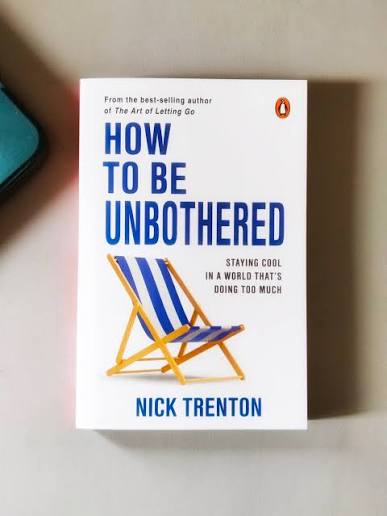
Book Title: How to Be Unbothered: The Art of Emotional Detachment, Mental Peace, and Letting Things Go
Author: Nick Trenton
Rating: ⭐⭐⭐⭐⭐ 5.0 / 5.0 (Essential Reading)
Quick Summary: In a culture that conditions us to treat every passing comment, delayed email, and minor inconvenience as an emergency, How to Be Unbothered by Nick Trenton offers a grounded, practical toolkit for reclaiming mental real estate. It is not an argument for apathy, callousness, or hiding from the world; rather, it is a guide on choosing conscious responsiveness over compulsive reactivity.
1. The Trap of Modern Over-Investment
Most people do not suffer from a lack of care; they suffer from caring about too many trivial things at maximum intensity.
From office friction and unreturned text messages to strangers cutting into traffic and the continuous flood of online outrage, our nervous systems are kept on high alert. We treat minor friction as a personal insult or an existential crisis.
In How to Be Unbothered, Nick Trenton examines why modern professionals and overthinkers find themselves perpetually drained:
- The Obligation to React: We assume that having a feeling requires expressing it or taking immediate action.
- The Ego’s Need for Control: We exhaust ourselves trying to control other people’s perceptions, behaviors, and timelines.
- Catastrophizing Minor Roadblocks: A delayed project or critical remark is magnified into an indictment of our competence or future security.
Trenton’s foundational premise is straightforward: Peace is not the absence of chaos; it is the refusal to let outside chaos dictate your internal state.
2. Emotional Detachment vs. Indifference: Understanding the Distinction
A frequent objection to becoming “unbothered” is the fear of turning cold, detached, or irresponsible. Trenton clarifies this distinction early on.
- Indifference / Apathy: Denying your emotions, neglecting relationships, avoiding responsibilities, and pretending nothing matters.
- Healthy Emotional Detachment: Caring deeply about your core values and principles while letting go of how external circumstances unfold moment to moment.
  ┌─────────────────────────────────────────────────────────────────┐
  │                   THE REACTIVITY SPECTRUM                       │
  ├───────────────────────────────┬─────────────────────────────────┤
  │ HYPER-REACTIVE (Default)      │ EMOTIONALLY UNBOTHERED          │
  ├───────────────────────────────┼─────────────────────────────────┤
  │ Trigger ──▶ Immediate Reaction│ Trigger ──▶ PAUSE ──▶ Response  │
  │ Absorb everyone's tension     │ Observe without absorbing       │
  │ Needs the last word           │ Values peace over winning       │
  │ Seeks outside validation      │ Anchored in internal clarity    │
  └───────────────────────────────┴─────────────────────────────────┘
When you are unbothered, you do not stop loving people or striving for excellence in your career. You simply stop allowing external events to shake your inner equilibrium. You preserve your energy for battles that genuinely matter.
3. The 3 Core Pillars of Trenton’s “Unbothered” Framework
Pillar 1: Expand the Gap Between Stimulus and Response
Borrowing from classical Stoicism and cognitive behavioral therapy, Trenton highlights the brief window between when an event occurs and how we respond:
- An irritating email lands in your inbox.
- Your initial impulse is defensiveness, irritation, and an immediate sharp reply.
- The “Unbothered” method inserts a mandatory pause: take three deep breaths, step away from the keyboard, and examine the urge to react.
By lengthening this gap, you shift control from your reactive survival instincts to deliberate, reasoned thinking.
Pillar 2: The Radical Reduction of Personalization
Much of what upsets us has little to do with us.
- A colleague’s curt response often reflects their own deadline pressure, lack of sleep, or private worries—not a calculated slight against you.
- When people project negativity, anger, or passive aggression, it is an outward display of their internal state.
Trenton encourages readers to treat other people’s bad moods as weather patterns. You would not take a thunderstorm personally or spend hours arguing with the rain; you simply carry an umbrella. Treating workplace tension and difficult personalities the same way prevents unnecessary mental strain.
Pillar 3: Disengaging from the Need for Validation
Why do we get drawn into pointless arguments, both online and around the dinner table? Because our ego demands that everyone acknowledge our perspective.
Trenton argues that needing the last word is a clear sign of internal insecurity. True confidence does not require universal agreement. Letting someone hold an inaccurate opinion of you without correcting them is one of the highest forms of mental freedom.
4. Deconstructing Common Triggers: A Tactical Playbook
Trenton provides actionable mental models for handling daily stress:
A. The “Will It Matter in 5 Years?” Filter
When an unexpected problem arises—a missed deadline, a dented car, or a cancelled flight—apply the 5-5-5 perspective rule:
- Will this matter in 5 minutes? (Often yes, you feel the spike).
- Will this matter in 5 weeks? (Rarely; adjustments will have been made).
- Will this matter in 5 years? (Almost never).
If an issue won’t matter in 5 years, do not spend more than 5 minutes agonizing over it.
B. Giving Up the Illusion of Control
Draw a firm circle around two categories:
- Things Within Your Direct Control: Your preparation, tone of voice, integrity, effort, and responses.
- Things Outside Your Control: Market corrections, company restructurings, other people’s habits, and the weather.
Agony occurs when we spend 90% of our energy worrying about category two. The unbothered approach channels all focus into category one and accepts category two with calm realism.
5. Key Takeaways from How to Be Unbothered
- Emotional bandwidth is finite: Every petty argument or minor grievance you entertain drains energy from your genuine goals and loved ones.
- Calm is a disciplined choice: Remaining composed under pressure is not an accident of personality; it is a habit built through deliberate pauses.
- Silence is a powerful boundary: You do not need to attend every argument you are invited to. Sometimes, simple silence is the most effective response.
Final Verdict & Rating
How to Be Unbothered by Nick Trenton is a refreshingly straightforward, no-nonsense manual for modern overthinkers. It avoids vague platitudes in favor of practical mental models and direct cognitive reframing.
If you find yourself constantly drained by workplace dynamics, second-guessing everyday interactions, or reacting intensely to every minor setback, this book offers a clear path toward sustainable mental calm.
⭐ Rating: 5.0 out of 5.0 Stars — An essential addition to your personal development shelf.
👉 Grab Your Copy on Amazon:
Search & Buy “How to Be Unbothered” by Nick Trenton on Amazon (Title: How to Be Unbothered: The Art of Emotional Detachment, Mental Peace, and Letting Things Go)