
By the FractionalTech Financial Research Desk
Category: Wealth Management & Advanced Investing
Target Audience: HNIs, Affluent Investors, Tactical Allocators, Wealth Managers
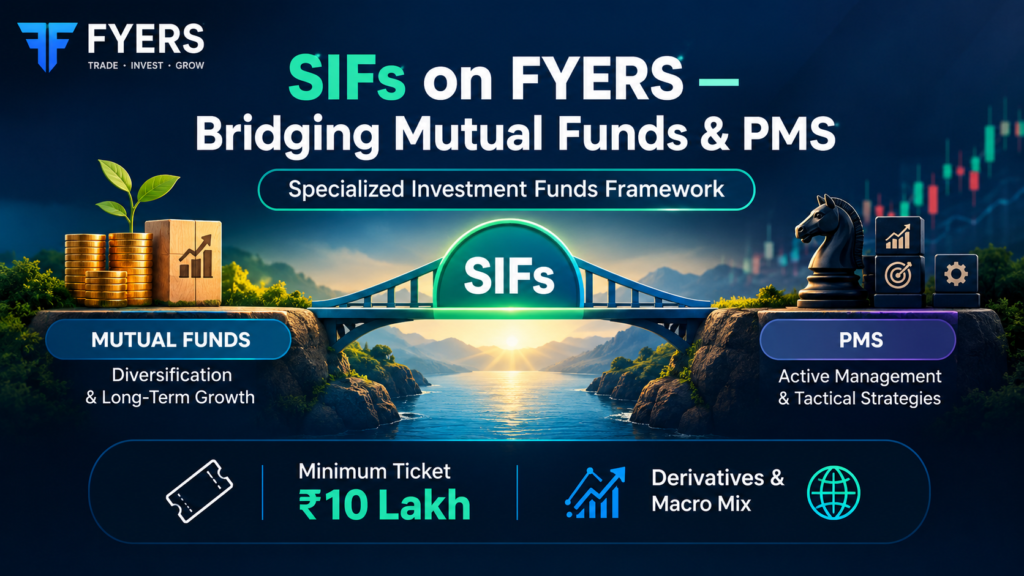
For decades, Indian investors seeking managed portfolios faced a stark binary choice: either stick to traditional retail Mutual Funds (MFs) with rigid mandates or jump straight to Portfolio Management Services (PMS), which require a steep, SEBI-mandated minimum capital commitment of ₹50 Lakh.
Under SEBI’s regulatory framework, an asset class bridges this divide: Specialised Investment Funds (SIFs). Leading discount and algorithmic trading platform FYERS has launched SIF access directly inside its ecosystem.
If you are wondering how SIFs operate, where fund managers allocate capital, what minimum ticket size is required, how the expense ratio is structured, and what returns you can anticipate across short, medium, and long horizons, this in-depth guide covers everything you need to know.
1. What Exactly is an SIF, and How Does It Fit on FYERS?
A Specialised Investment Fund (SIF) is a pooled investment vehicle established by SEBI-registered Asset Management Companies (AMCs). While governed under the broad mutual fund regulatory umbrella, SIFs are liberated from conventional mutual fund investment constraints.
In a standard equity mutual fund, managers are tightly bound by category concentration limits, strict market-cap mandates (e.g., Large-cap vs. Flexi-cap), and tight derivative usage rules that generally restrict F&O to pure hedging.
An SIF removes these handcuffs:
- Fund managers can hold concentrated, high-conviction portfolios.
- They can execute tactical sector rotation without benchmark-hugging.
- Under SEBI regulations, SIFs can allocate up to 25% of net assets to exchange-traded derivatives for tactical positioning and unhedged directional/long-short exposure.
- They can invest across unconstrained asset mixes, including listed equities, corporate debt, Real Estate Investment Trusts (REITs), Infrastructure Investment Trusts (InvITs), and commodities.
The FYERS Integration
On FYERS Web and App, SIFs sit seamlessly under the Mutual Funds $\rightarrow$ SIF tab. Instead of executing separate third-party paperwork or maintaining individual Demat accounts with external PMS houses, investors can evaluate, compare, and allocate to curated AMC SIF strategies using their registered bank accounts via Net Banking.
2. Structural Comparison: Mutual Funds vs. SIF vs. PMS
To understand where your capital works best, review the operational differences:
| Feature | Traditional Mutual Funds | Specialised Investment Funds (SIF) | Portfolio Management Services (PMS) |
| Regulatory Tier | SEBI MF Regulations | SEBI SIF Framework (within MF structure) | SEBI Portfolio Managers Regulations |
| Minimum Investment | ₹100 to ₹5,000 | ₹10 Lakh (at PAN level per AMC) | ₹50 Lakh |
| Execution Mode on FYERS | SIP or Lump-Sum | One-Time Lump-Sum | Custom Agreement / Discretionary |
| Derivative Exposure | Hedging & rebalancing only | Up to 25% for tactical / long-short | Variable (as per mandate) |
| Tax Treatment | Standard Equity / Debt MF capital gains | Taxed like Mutual Funds (Pass-through) | Individual trade-level business/capital taxation |
| Platform Fees on FYERS | Zero broker commission (Direct) | Zero platform or transaction fees | Separate management & hurdle profit-sharing |
3. How Does an SIF Actually Work Behind the Scenes?
When you subscribe to an SIF via FYERS, your capital follows an institutional execution pipeline:
 ┌─────────────────┐       ┌────────────────────────┐       ┌────────────────────────┐
 │   Investor on   │ ─────▶│ Pooled AMC SIF Fund    │ ─────▶│ Multi-Asset Deployment │
 │  FYERS Platform │       │ (NAV calculated daily) │       │ (Equities, Debt, REITs,│
 └─────────────────┘       └────────────────────────┘       │  Commodities & F&O)    │
   (Min: ₹10 Lakh)           (Regulated by SEBI)            └────────────────────────┘
- Capital Pooling: Investors allocate funds in ₹10 Lakh+ blocks. The AMC issues units backed by a clear Net Asset Value (NAV).
- Tactical Asset Allocation: Depending on macro market indicators, the fund manager actively adjusts asset weights:
- Bull Markets: Concentrates capital into high-beta equities, cyclical manufacturing, and mid-cap disruptors.
- Volatile / Bear Regimes: Deploys up to 25% derivative hedges/shorts, increases cash/arbitrage holdings, and moves capital into high-yielding corporate debt or gold.
- Execution & Allotment: Orders placed on FYERS settle typically within 3 to 5 business days, reflecting in your consolidated portfolio alongside your existing equity and F&O holdings.
4. Types of SIF Strategies Available
Leading fund houses (such as Kotak, Bajaj, ICICI Prudential, and others) design SIF strategies targeting specific investment objectives:
1. Long-Short & Absolute Return SIFs
These funds use a core portfolio of long cash equities combined with synthetic short futures or derivative options (up to 25%) to generate positive alpha regardless of whether the Nifty is trending upward or declining.
2. Unconstrained Sector Rotation & Momentum SIFs
Traditional mutual funds cannot hold oversized allocations in single industries. Momentum SIFs can shift exposure dynamically—for instance, rotating 60% of assets into defense and capital goods when capital expenditure cycles peak, and pivoting toward IT or FMCG when risk aversion rises.
3. Multi-Asset Tactical Hybrid SIFs
These strategies allocate flexibly across listed equities, Tier-1 corporate debt, Gold/Silver derivatives, and yield-bearing REITs/InvITs to minimize drawdowns during macro headwinds.
5. Expense Ratios and Cost Structures
Investors transitioning from mutual funds or evaluating PMS must scrutinize the cost drag:
- FYERS Platform Charges: Zero. FYERS does not levy platform, setup, or intermediary transaction brokerage on SIF investments. You pay the net subscription amount directly via Net Banking.
- AMC Total Expense Ratio (TER): SIF expense ratios generally range between 1.25% and 2.25% per annum, depending on the complexity of the strategy (e.g., active derivatives management vs. multi-asset allocation).
- No Profit-Sharing Drag: Unlike PMS models that charge a 1.5% fixed fee plus 15% to 20% performance fees above a hurdle rate, SIFs operate strictly within SEBI’s daily NAV and capped expense framework. This structure preserves a larger share of compounding returns for the investor during extended bull runs.
- Exit Loads & Stamp Duty: Mandatory government stamp duty (0.005%) applies at allotment. Exit loads are defined by the individual AMC strategy (typically 1% to 3% for exits prior to 12–24 months).
6. Return Expectations: Short, Medium & Long-Term
Because SIFs deploy tactical risk management and flexible mandates, their return profile behaves differently than plain-vanilla index funds:
                       REALISTIC SIF RETURN SPECTRUM

  HORIZON        ESTIMATED TARGET (CAGR)      PRIMARY PERFORMANCE DRIVERS
 ─────────────────────────────────────────────────────────────────────────────
  Short-Term     Capital Preservation         Derivatives hedging cushions market
  (1–12 Months)  to 8% – 12%                  drops; focus on low volatility.
 ─────────────────────────────────────────────────────────────────────────────
  Medium-Term    13% – 16% (Target Alpha)     Sector rotation gains traction;
  (1–3 Years)                                 captures multi-quarter cyclical trends.
 ─────────────────────────────────────────────────────────────────────────────
  Long-Term      15% – 18%+                   Full compounding of concentrated
  (3–5+ Years)                                holdings without index-hugging drag.
- Short Run (1 Year or less): SIFs are not designed for quick speculation. In the short run, performance depends on the fund manager’s tactical cash and derivative positioning. In sideways or declining markets, long-short SIFs generally outperform long-only mutual funds by mitigating steep drawdowns.
- Medium Run (1 to 3 Years): SIFs allow managers to capitalize fully on specific industrial themes without being forced to dilute winners into lower-conviction stocks.
- Long Run (3 to 5+ Years): Over multi-year cycles, eliminating index-hugging while avoiding the performance-fee drag of PMS vehicles enables top-quartile SIFs to generate significant risk-adjusted alpha over broad market benchmarks like the Nifty 50 or BSE 500.
7. How to Subscribe to SIFs on FYERS: Step-by-Step
Getting started through the FYERS interface takes only a few minutes:
- Verify Capital Readiness: Ensure you have the mandatory minimum ticket of ₹10,00,000 available in your registered bank account.
- Access the SIF Portal:
- Log in to FYERS Web (trade.fyers.in) or launch the FYERS Mobile App.
- Navigate to the Mutual Funds module from the dashboard menu.
- Click on the dedicated SIF tab.
- Analyze Strategies: Review available schemes, fund manager credentials, sector concentrations, risk metrics, and strategy documents.
- Execute One-Time Order: Select your scheme, input the investment amount ($\ge ₹10 \text{ Lakh}$), authorize payment via registered Net Banking, and complete authentication.
- Portfolio Tracking: Track unit allocations and daily NAV performance directly within your unified FYERS portfolio view.
👉 Direct Subscription Portal:
Access the mutual fund and SIF dashboard directly at: FYERS Mutual Funds & SIF Platform (Navigate: Products $\rightarrow$ Mutual Funds $\rightarrow$ SIF tab).
8. Strategic Recommendation: Should You Invest?
- Recommended For:
- Affluent investors with an existing equity mutual fund base seeking higher alpha.
- High-Net-Worth Individuals (HNIs) who find the ₹50 Lakh PMS entry barrier excessive or dislike PMS profit-sharing models.
- Investors seeking professional tactical allocation across equities, commodities, and hedging instruments.
- Not Recommended For:
- First-time retail equity investors (stick to low-cost Nifty 50 Index funds or Flexi-cap mutual funds).
- Individuals requiring immediate liquidity or monthly systematic withdrawals.
👉 Get Started Today: Click here to open your Free FYERS Account with referral code FRNNG9L and unlock your ₹2,000 trading credits.
⚠️ Statutory Regulatory Disclosure & Risk Warning
Statutory Investment & Risk Disclosure:
Mutual Fund investments and Specialised Investment Funds (SIFs) are subject to market risks; read all scheme-related offer documents, Strategy Information Documents (SID), and Key Information Memorandums (KIM) carefully before investing. Units of SIF schemes are subject to market fluctuations, macroeconomic volatility, derivative risks, credit risks, and operational factors. Historical returns are purely illustrative and do not guarantee future performance.
The analysis, expense comparisons, and projected return ranges detailed in this publication are intended strictly for educational and informational purposes. This content does not constitute personal financial, tax, or investment advice, nor does it represent an endorsement or recommendation of any specific AMC or broker.
The authors and the FractionalTech Research Desk are NOT SEBI-registered Investment Advisers (IA) or Portfolio Managers. SIFs carry a minimum investment threshold of ₹10,00,000 and involve advanced multi-asset and derivative strategies. Prospective investors should consult a certified, SEBI-registered financial adviser and independent tax consultant before committing capital.